




Walking through the halls of MHS, Vidvath Venkataraman, senior, notices trends everywhere: UGGs, quarter zips, Parke sweatshirts, Labubus and Owalas are becoming more widespread with each day they are trending.
“If a lot of people like how something looks, the trend will stick,” Venkataraman said.
Venkataraman said he often buys into trends because it allows him to fit in, recently wearing a quarter zip to look cool. He sees several advertisements such as clothing, shoes and skincare products each time he scrolls through Instagram, which sometimes leads to him making impulsive purchases, Venkataraman said.
“I bought a ton of blind boxes for myself because I kept seeing blind box videos on TikTok,” Venkataraman said. “I’m willing to spend like $30 on a trend, I’m kind of a bandwagon.”
As different trends grow in popularity, students regularly feel the need to purchase products, whether they need them or not, to fit in with those around them.
Defining Materialism
Dr. Marsha Richins, Associate Dean of Graduate Programs and Research at the University of Missouri-Columbia, researched consumer values and the influence of advertising on self-perceptions. She said materialism is the belief that buying or having something will change a person’s life in a meaningful way, and the concept of materialism has existed for thousands of years.

“It’s not a bad thing to want things,” Dr. Richins said. “It’s not such a good thing when people have unrealistic expectations about how all these purchases they’re making will improve their lives.”
Marketing Products
Dr. Richins said advertisements may not directly say that the product or experience would improve the buyer’s life, but instead they show and tell ways they could by presenting a certain image of how people will feel once they have the product.
“Marketers don’t have to make any of these promises about these changes, they just have to suggest that these changes might occur if you buy these things,” Dr. Richins said.
Eric Doerhoefer, business teacher, said marketing overall evolves with trends and feeds into a consumerist society. He said consumerism drives purchases, which allows businesses to grow and economies to thrive.
“I don’t think people want to view consumerism in a positive light; however, we are living in objectively the most consumer-driven time in human history whether people enjoy participating in it or not,” Doerhoefer said.
Doerhoefer said his business management classes work on creating a brand, and students choose what they are selling and how to advertise it.
“Consistency and identity are the most important aspects of a brand,” Doerhoefer said. “Whatever you put out for customers to see is an extension of your brand.”
Consumer Psychology
Brands often use the tactics of sex and celebrity appeal to encourage people to purchase their products, Ashley Hobbs, AP Psychology teacher, said.
“Why is it that you use Micheal Jordan to promote Gatorade or LeBron James and Hummer?” Hobbs said. “Because people are like ‘I want what that guy has, he is the most successful in his field. I want that kind of recognition.’”
Hobbs said another common thing people face when consuming items is the Facebook Effect, which is when people see what others are posting on their social media and then they compare their whole lives to just the highlights that are getting posted.
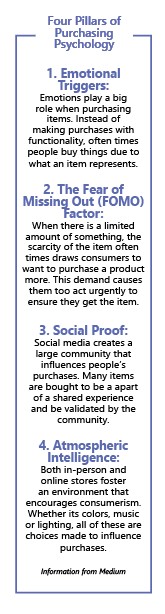
This then causes people to feel left behind, enforcing the idea that they need to keep up with popular trends, Hobbs said, once the items are purchased people often get a hit of dopamine, which elevates feelings of happiness for brief periods.
“If we come to rely on purchased items to give us those hits of dopamine, and that happiness, then we can lose the ability to feel joy and happiness from other things,” Hobbs said.
Hobbs said a common misconception is that money and material possessions correlate to happiness, but really it’s having meaningful connections and a fulfilling career and life that leads to happiness.
“In actuality, with long term happiness, like wealth and material items aren’t what gives us that,” Hobbs said. “It makes it easy, it makes it fun. It doesn’t necessarily make us happier.”
Student Perspective
Noah Southerland, senior, said when he purchases items he focuses on its practicality, but there can be both pros and cons for every trend.
“It helps foster that sense of togetherness,” Southerland said. “On the other hand, if we ascribe too much to trends, it takes away from the sense of individuality that some people want to express.”
Southerland said companies that sell similar products use psychology to show consumers why they should purchase one product over another.
“Consumer culture is when all of those things culminate into the idea that money is more something that should be used on material possessions that are trendy or help people feel fulfillment,” Southerland said.
Southerland has noticed that social media has promoted popular brands like Nike and Lululemon, which have become status symbols for high school students.
Around 62% of adults who use TikTok utilize it as a resource for product reviews, according to Pew Research.
“So when it comes to social media and helping perpetuate these ideas, and these brands taking advantage of that, you’re seeing a continued cycle of these brands and these trends as basically a representation of consumer culture,” Southerland said.